The Third Pole is Bare: Why "Mitigation" is a Luxury We Can't Afford
For the Global North, the loss of Himalayan snow is a tipping point. For us, it is a survival point.

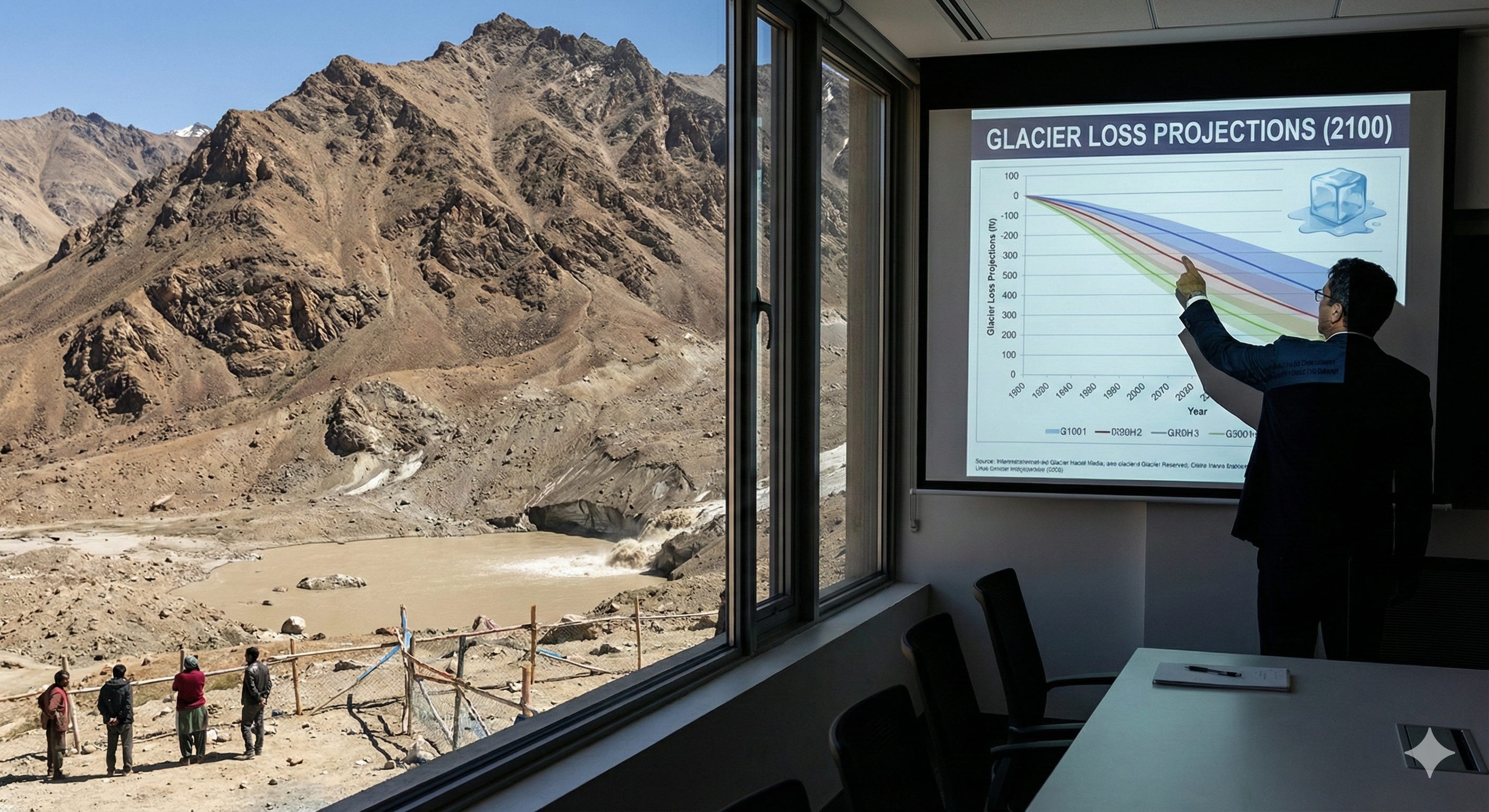
If you look at the Himalayas today, you will see something terrifying: Brown rock.
According to meteorologists, the 2024-25 winter saw a 23-year record low in snow persistence, nearly 24% below normal. The mountains are bare.
For the Global North, this is a tragedy of scenery and science. They mourn the “Third Pole” because it is a planetary cooling system. They worry about albedo effects and long-term sea-level rise.
But here in the Global South, we do not have the luxury of mourning “cooling points.” For us, this bare rock is not a climate statistic; it is a loaded gun pointed at our economy, our safety, and our sanity.
The Anatomy of Climate Anxiety
In the North, “Climate Anxiety” is often discussed as a mental health condition, a fear of the future. In the Indus Basin, climate anxiety is the fear of tomorrow.
When the “Westerly Disturbances” (the weather systems that bring winter snow) become “feeble” or track too far north, as they have this year, the impact is immediate.
The Feedback Loop: Bare mountains are dark. They absorb heat instead of reflecting it. This triggers a feedback loop where the lack of snow accelerates the melting of the glaciers that remain.
The Soil Trap: Without snowmelt to feed the rivers in spring, our soil dries out. In the Indus Delta, the reduced river flow allows the Arabian Sea to push saltwater 64–84 km inland, poisoning over 1.2 million acres of once-fertile land.
The “Mitigation” Trap
The Global North loves to talk about Mitigation (cutting emissions). They hold summits and sign pledges to keep 1.5°C alive.
But let’s be honest: Mitigation is too slow to save us.
Even if the world went Net Zero today, the Himalayas would continue to melt for decades due to the heat already locked in the system.
We cannot wait for the North to fix their smokestacks.
We need Adaptation NOW.
We need reservoirs to capture the flash floods when the “Glacial Lakes” burst (GLOFs). We need salt-resistant crops for the delta. We need early warning systems for the landslides that happen when the ice, which acts as “cement” for the mountain slopes, vanishes.
The Reality of a “Snow Drought”
Scientists are calling this a “Snow Drought”.
In Northwest India, snowfall has dropped by 25% in just the last five years.
Snowmelt provides 25% of the annual water for 12 major river basins.
When that tap turns off, it doesn’t just mean “less water.” It means salt in our soil, debris flows in our villages, and heat in our cities.
The North sees a melting glacier and thinks of the year 2100. We see a melting glacier and think of the harvest next month. It is time we stopped waiting for them to save the ice, and started building the walls to survive the water.